The AACSB accredited programme provides state-of-the-art business education with real-world learning experiences, which equips graduates with the knowledge and competencies required to successfully perform planning, management, and coordination tasks within tourism businesses, multinational companies, governmental organisations, tourism planning and development institutions, NGOs, and other not-for-profit organisations at local, regional, national, and international levels.

  • have previously studied tourism and would like to gain a deeper understanding of tourism as both a social phenomenon and a dynamic industry;
  • wish to complement knowledge acquired in other academic disciplines with specialised expertise in tourism;
  • enjoy addressing complex challenges and bringing together diverse interests to achieve common goals;
  • are interested in keeping pace with international trends while maintaining awareness of national and local characteristics;
  • are motivated by complex professional tasks, such as destination management and the coordination of large-scale tourism enterprises;
  • would like to contribute to the preparation and implementation of successful tourism development projects;
  • aspire to pursue senior management and leadership positions within the tourism sector.
  • tourism destination management organisations (DMOs);
  • national tourism administration and management bodies;
  • hotels and international hotel chains;
  • tour operators and conference organisers;
  • environmental protection organisations and national parks;
  • cultural institutions and event management companies;
  • sports facilities and sports event organisations;
  • research institutes, consultancy firms, and project development agencies;
  • higher education institutions offering tourism-related programmes.

In addition, the knowledge and skills acquired during the programme equip graduates with the competencies required to establish and successfully manage their own tourism-related businesses.

Bachelor’s degree (or higher) in tourism and hospitality or in another the field in business, economics and management.

Application without precondition:

Students with (BA/BSc) degree in Tourism and Hospitality or Business Administration and Management (or an equivalent degree of higher education) degrees, the credit acceptance is not required.

Application with precondition:

Applicants holding a degree of any level of higher education (BA/BSc, MA/MSc) except for the above mentioned programmes, the credit acceptance is required

Altogether 60 credit points from five study areas are required:

  • Methodological knowledge fields (like Mathematics, Statistics, Information Technology, etc.): 15 credit points
  • Economics knowledge fields (like Microeconomics, Macroeconomics, International Economics, Regional Economics, Economics History): 10 credit points
  • Business knowledge (like Corporate Economics, Corporate Finance, Marketing, Accounting, etc.): 15 credit points
  • Social sciences knowledge fields (like Sociology, Psychology, Philosophy, etc.): 10 credit points
  • Management knowledge fields (like Strategic planning; Controlling; Human Resource Management, Leadership and Management, etc.): 10 credit points

Out of the 60 credits, 40 credits are required in the methodological, economic, business, social sciences and management knowledge areas and 20 credits in the field of tourism and hospitality.

Applicants need to have at least 30 credits before admission, the missing credits can be completed during the master studies. Students who do not have prior credits in the field of tourism and hospitality are required to complete credits in Foundations of Tourism, Hotel Management, Tourism Marketing, and one additional tourism-specific subject.


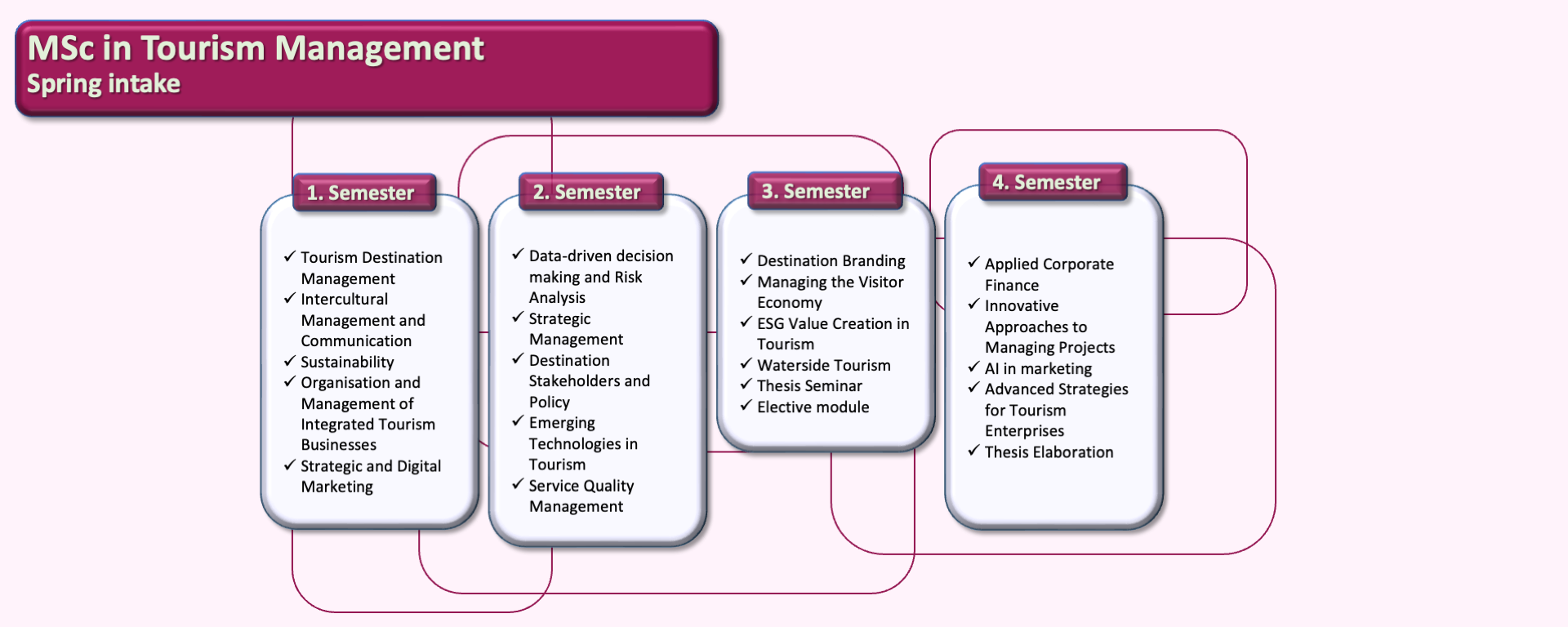
The information provided below is for general guidance and informational purposes only. For a detailed and authoritative description of the programme, please refer to the official curriculum.

Foundation core modules:

  • Data-driven Decision Making and Risk Analyses
  • Strategic Management
  • Destination Stakeholders and Policy
  • Emerging Technologies in Tourism
  • ESG Value Creation in Tourism
  • Applied Corporate
    Finance
  • AI in Marketing
  • Intercultural Management and Communication
  • Sustainability
  • Service Quality Management
  • Strategic and Digital Marketing
  • Destination Branding
  • Innovative Approaches to Managing Projects

Tourism specific modules:

  • Tourism Destination Management
  • Organisation and Management of Integrated
    Tourism Businesses
  • Advances Strategies for Tourism Enterprises
  • Managing the Visitor Economy
  • Waterside Tourism

Dissertation work

More information about the MSc in Tourism Management:

Dr. Ágnes Nóra RAFFAY-DANYI

Associate Professor
Building “A” 1st floor 107
Phone: +36 88 624 – 128
e-mail: raffay.agnes@gtk.uni-pannon.hu

Tünde VAJDA

International coordinator
Building “A” 2nd floor Room 223
Phone: +36 88 624 – 136
e-mail: vajda.tunde@gtk.uni-pannon.hu